Ibogaína
Herbarias(1R,15R,17S,18S)-17-ethyl-7-methoxy-3,13-diazapentacyclo[13.3.1.02,10.04,9.013,18]nonadeca-2(10),4(9),5,7-tetraene
Estructura molecular
Efectos
Mecanismo de acción
... In this study, /investigators/ first characterized the actions of ibogaine on ethanol self-administration in rodents. Ibogaine decreased ethanol intake by rats in two-bottle choice and operant self-administration paradigms. Ibogaine also reduced operant ethanol self-administration in a relapse model. Next, /investigators/ identified a molecular mechanism that mediates ibogaine's desirable activities on ethanol intake. Microinjection of ibogaine into the ventral tegmental area (VTA), but not the substantia nigra, reduced ethanol self-administration, and systemic ibogaine administration increased expression of glial cell line-derived neurotrophic factor (GDNF) in a midbrain region that includes the VTA. In dopaminergic-like SHSY5Y neurons, ibogaine treatment upregulated the GDNF pathway as indicated by increases in phosphorylation of the GDNF receptor, Ret, and the downstream kinase, ERK1 (extracellular signal-regulated kinase 1). Finally, ibogaine-mediated decrease in ethanol self-administration was mimicked by intra-VTA microinjection of GDNF and was reduced by intra-VTA administration of anti-GDNF neutralizing antibodies. Taken together, these results suggest that GDNF in the VTA mediates ibogaine's action on ethanol consumption. These findings highlight the importance of GDNF as a novel target for alcoholism drug development that may mimic ibogaine's effect against alcohol consumption but avoid negative side effects. Ibogaine (Endabuse) is a psychoactive indole alkaloid found in the West African shrub, Tabernanthe iboga. This drug disrupts cocaine and amphetamine abuse and has been proposed for treating addiction to these stimulants. However, the mechanism of action that accounts for its pharmacological properties is unclear. Given that previous studies demonstrated differential effects of psychotomimetic drugs (cocaine and methamphetamine) on neuropeptides such as neurotensin (NT), the present study was designed to determine: (1)
Vida media
To investigate the pharmacokinetic properties of ibogaine, a putatively anti-addictive alkaloid, levels of this drug in plasma and tissues were quantified up to 3 hours after i.v. infusion in rats. Immediately after a 31-35 min infusion (20 mg/kg). ... The plasma time course in 5 of 7 animals demonstrated an excellent fit to a two-compartment pharmacokinetic model, with alpha and beta half-lives of 7.3 min and 3.3 h, respectively. ...
Toxicidad
/SRP:/ Immediate first aid: Ensure that adequate decontamination has been carried out. If patient is not breathing, start artificial respiration, preferably with a demand-valve resuscitator, bag-valve-mask device, or pocket mask, as trained. Perform CPR if necessary. Immediately flush contaminated eyes with gently flowing water. Do not induce vomiting. If vomiting occurs, lean patient forward or place on left side (head-down position, if possible) to maintain open airway and prevent aspiration. Keep patient quiet and maintain normal body temperature. Obtain medical attention. /Poisons A and B/ /SRP:/ Basic treatment: Establish a patent airway (oropharyngeal or nasopharyngeal airway, if needed). Suction as necessary. Watch for signs of respiratory insufficiency and assist ventilations if necessary. Administer oxygen by nonrebreathing mask at 10 to 15 L/min. Monitor for pulmonary edema and treat if necessary ... . Monitor for shock and treat if necessary ... . Anticipate seizures and treat if necessary ... . For eye contamination, flush eyes immediately with water. Irrigate each eye continuously with 0.9% saline (NS) during transport ... . Do not use emetics. For ingestion, rinse mouth and administer 5 ml/kg up to 200 ml of water for dilution if the patient can swallow, has a strong gag reflex, and does not drool ... . Cover skin burns with dry sterile dressings after decontamination ... . /Poisons A and B/ /SRP:/ Advanced treatment: Consider orotracheal or nasotracheal intubation for airway control in the patient who is unconscious, has severe pulmonary edema, or is in severe respiratory distress. Positive-pressure ventilation techniques with a bag-valve-mask device may be beneficial. Consider drug therapy for pulmonary edema ... . Consider administering a beta agonist such as albuterol for severe bronchospasm ... . Monitor cardiac rhythm and treat arrhythmias as necessary ... . Start IV administration of D5W /SRP: "to keep open", minimal flow/. Use 0.9% NS
Farmacología
Drugs capable of inducing illusions, hallucinations, delusions, paranoid ideations, and other alterations of mood and thinking. Despite the name, the feature that distinguishes these agents from other classes of drugs is their capacity to induce states of altered perception, thought, and feeling that are not experienced otherwise. Drugs that bind to but do not activate excitatory amino acid receptors, thereby blocking the actions of agonists. To investigate the pharmacokinetic properties of ibogaine, a putatively anti-addictive alkaloid, levels of this drug in plasma and tissues were quantified up to 3 hours after i.v. infusion in rats. Immediately after a 31-35 min infusion (20 mg/kg), mean plasma ibogaine levels were 373 ng/mL; these values rapidly declined thereafter in a biexponential manner. The plasma time course in 5 of 7 animals demonstrated an excellent fit to a two-compartment pharmacokinetic model, with alpha and beta half-lives of 7.3 min and 3.3 h, respectively. Drug clearance was estimated at 5.9 L/h (n = 7). Ibogaine levels in brain, liver, and kidney 3 h after the end of drug infusion were 143-170 ng/g, close to simulated values for the peripheral pharmacokinetic compartment. However, drug levels at 3 h in adipose tissue were much higher (3,328 ng/g), implying the need for a more complex pharmacokinetic model. Mechanisms for the initial and rapid disappearance of plasma ibogaine are believed to include metabolic demethylation as well as redistribution to body depots. Sequestration of ibogaine by adipose tissue likely contributes to a prolonged persistence of drug in the body. This persistence may be underestimated by the beta half-life reported in the present study. The distribution of the putatively anti-addictive substance ibogaine was measured in plasma, brain, kidney, liver, and fat after ip and sc administration in rats. One hour after ip dosing (40 mg/kg), drug levels ranged from 106 ng/ml (plasma) to 11,308 ng/g (fat), with signif
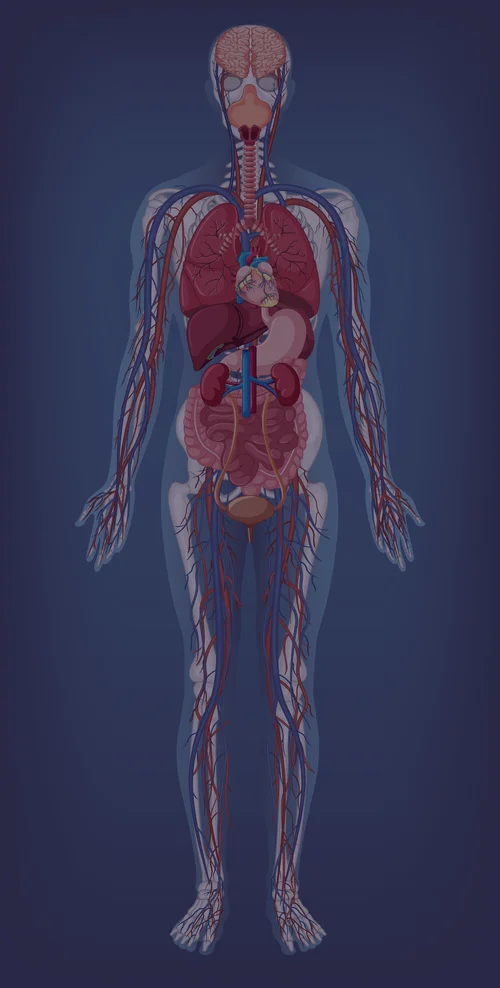
Diagrama corporal
To investigate the pharmacokinetic properties of ibogaine, a putatively anti-addictive alkaloid, lev
1-2 horas
12-36 horas
30-60 minutos (oral)
Oral: ~50-70%
Hígado
Renal (metabolitos), biliar
Alto, >10 L/kg (gran afinidad por tejido adiposo)
Timeline farmacocinético
Riesgos para la salud — Calculadora de dosis
Advertencias
- Contraindicada en cardiopatías preexistentes
- Requiere monitoreo cardíaco continuo
- No usar sin supervisión médica especializada
- Riesgo de muerte súbita por arritmia
- Almacenamiento prolongado en tejido adiposo
Combinaciones peligrosas
Descripción
La ibogaína es un alcaloide indólico derivado de la corteza de la raíz de Tabernanthe iboga, una planta originaria de África central. Es utilizada en ceremonias Bwiti en Gabón como sacramento espiritual. Ha sido investigada extensamente como tratamiento para la adicción a opioides, ya que puede reducir drásticamente los síntomas de abstinencia y el deseo de consumo. Actúa sobre múltiples sistemas de neurotransmisores incluyendo receptores opioides, NMDA, serotonina y sigma. Sin embargo, presenta riesgo significativo de cardiotoxicidad, prolongando el intervalo QT y pudiendo causar arritmias fatales.
Referencias
Datos farmacológicos obtenidos de PubChem (CID: 197060) — NIH National Library of Medicine
Evidencia científica y ensayos clínicos
Psilocybin and Ibogaine in Cocaine-Seeking: Extinction Enhancement Without Relapse Prevention.
Koutrouli IRA et al. · Addiction biology · 2026
Neural correlates of ibogaine: Evidence from functional neuroimaging of military veterans.
Sridhar M et al. · Biological psychiatry. Cognitive neuroscience and neuroimaging · 2026
Ibogaine: Therapeutic Potential, Cardiac Safety, and Translational Perspectives in the Treatment of Substance Use Disorders-A Scoping Review.
Esperança MP et al. · Molecules (Basel, Switzerland) · 2026
Neurorestorative Properties of Ibogaine: Linking Multi-Receptor Affinities to Remyelination and Metabolic Restoration.
Calvey T et al. · Acta neuropsychiatrica · 2026
Psychedelic Modulation of Excitation/Inhibition Balance: A Dual-Phase Neurodevelopmental Model.
Kandilakis CL et al. · ACS chemical neuroscience · 2026
Deciphering Ibogaine's Matrix Pharmacology: Multiple Transporter Modulation at Serotonin Synapses.
Hwu C et al. · Journal of the American Chemical Society · 2026
Ibogaine's potential role in supporting reward system recovery across diagnostic boundaries.
Nicolas M · Frontiers in pharmacology · 2025
Ibogaine: Revisiting an Ancient Alkaloid for Modern Opioid Dependence.
Moore MD et al. · Substance use & misuse · 2025
Selective Delivery of Anticancer Natural G-Quadruplex Ligands by the AT11 Aptamer for Gastric Cancer Treatment.
Platella C et al. · Journal of medicinal chemistry · 2026
Mystical experiences during magnesium-Ibogaine are associated with improvements in PTSD symptoms in veterans.
Brown RE et al. · Journal of affective disorders · 2026